
Institutional Adoption Strategy
The reimbursement ground shifted on January 1, 2026. Most commercial teams knew a change was coming; fewer understood what it would do to the people carrying their products into committee rooms.

Written by
Dale Hogeland . CEO & Founder
Published
What Actually Changed
In the Calendar Year 2026 Medicare Physician Fee Schedule Final Rule, CMS reclassified most skin substitute products from biologics to “incident-to” supplies and set a single flat national rate of roughly $127 per square centimeter.1 That replaced a model that, in some cases, had generated reimbursement many times higher than that.
Medicare Part B spending on skin substitutes rose from about $252 million in 2019 to over $10 billion by 2024.2 CMS acted, and the rate changed.
Two weeks before the change took effect, CMS withdrew the finalized Local Coverage Determinations that had been scheduled to accompany the payment change.3 The payment policy remained in place; the LCDs were pulled. The result: a reimbursement rate change landed at the same time coverage guidance disappeared, creating layered uncertainty across the category.
The Common, But Dangerous, Instinct
When Q1 2026 numbers began to reflect the new environment, many organizations read them as a pricing and access problem: lower prices, expanded financing, and the removal of upfront cost barriers.
Those responses address real friction. But they often miss the real failure mode.
Programs that defer payment assume reimbursement will later close the financial gap. Under the old model, that worked. Under the new flat rate, the spread that powered those programs compressed. The access problem is smaller. The economic problem remains.
The committee didn’t get more skeptical. The financial case the champion was carrying got materially weaker.
The committee is asking the same questions it always asks. But the answers they’re hearing assume last year’s reimbursement rules.
It’s a justification problem.
What The Data Shows
The Q1 picture points to a channel split.
Private-office and associated-care settings… the channels most dependent on the old ASP-based spread… saw the sharpest declines. Hospitals and wound centers, where products compete on clinical value and total cost-of-care logic, exhibited different dynamics; some organizations reported early signs of stabilization as the quarter progressed.4
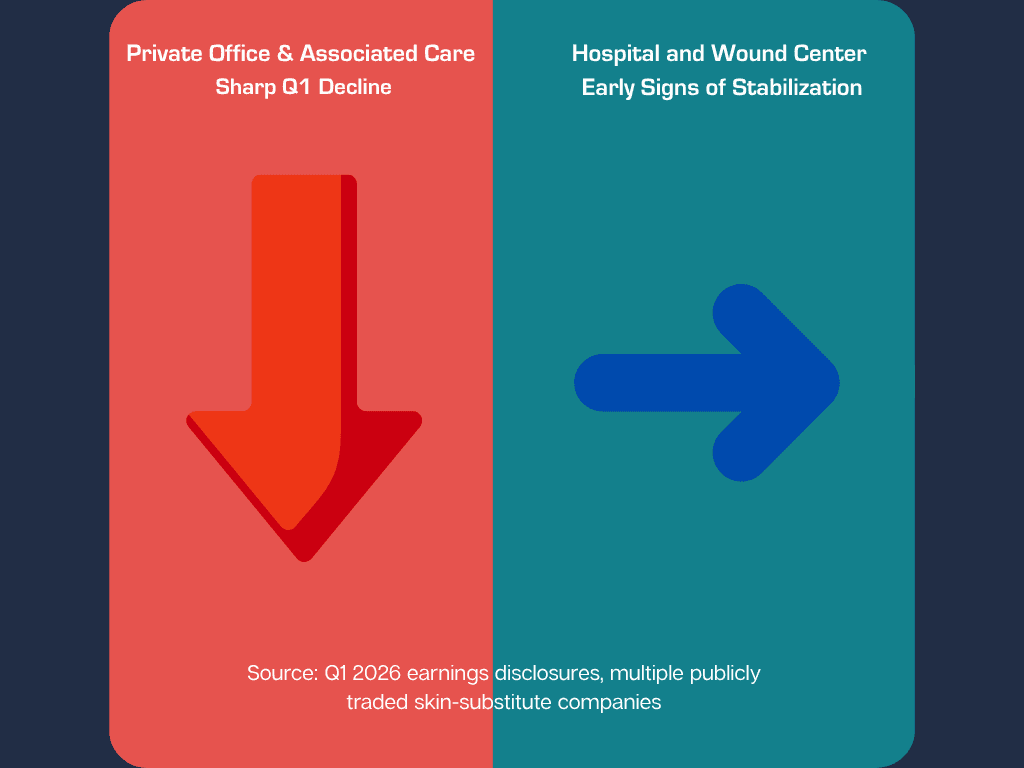
That split matters. It tells you the problem is channel-specific. It also tells you where the recovery path runs: the institutional channel is where the financial justification must be rebuilt for the current environment.
Where Adoption Actually Breaks
Your champion still walks into the committee room with the same clinical evidence they carried in 2025. The outcomes data haven’t changed. What has changed is the financial framework the committee uses to evaluate the product. The justification your champion needs to survive that room is different now.
I spent 15 years as an Acute Dialysis and VNA wound care nurse combined. I was at the end of the adoption chain, the point where a product either arrived with enough institutional support behind it to be used confidently, or it arrived as an afterthought no one had thought to carry past the committee.
What To Do Before The Next Committee Meeting
Three things matter. The first is the one most teams skip.
Audit the financial defense your champion is carrying. Not the clinical evidence. The financial case. Does it address the 2026 reimbursement framework or the 2025 one? Does it speak to this facility’s margin exposure, patient volume, and DRG profile, or does it rely on industry averages that no longer apply?
Identify the specific institutional friction. The reimbursement reset created a primary Financial Boulder in many cases. It also triggered secondary stalls: clinicians uncertain about documentation, supply chains waiting for coverage guidance, and champions who can’t answer the CFO’s questions. Each stall needs a different response.
Build the justification layer required by the current environment. Not lower prices. Not broader access programs. A rebuilt financial and operational case that goes into the room with your champion and holds up when the committee asks the harder questions of 2026.
Companies that navigate this transition best aren’t simply reacting fastest. They diagnose which friction is actually blocking adoption in their specific institutional channel, then build the response that friction requires.
If you want a quick diagnostic
If you want a short, practical diagnostic of where adoption is breaking down in your institutional channel, I built a brief audit that maps specific friction points and recommends what to fix first.
See the overview here: clearsignalconsulting.co/the-audit
Sources
1. Centers for Medicare and Medicaid Services. Calendar Year 2026 Medicare Physician Fee Schedule Final Rule (CMS-1832-F). Published October 31, 2025. Effective January 1, 2026. cms.gov
2. Hendershot Cowart P.C. “CMS Fundamentally Restructures Skin Substitute Payments for 2026.” December 2025. hchlawyers.com
3. Association for Advancing Tissue and Biologics (AATB). Statement on CMS LCD Withdrawal. December 26, 2025. aatb.org/news/cms-withdraws-local-coverage-determinations-certain-skin-substitutes
4. Multiple Q1 2026 earnings disclosures, publicly traded skin substitute companies. April–May 2026. sec.gov (EDGAR)


